


How Old Is Too Old for an AC in Tropical Climates — and What It Means for Southwest Florida Homeowners
How old is too old for an AC in tropical climates is a question every homeowner in Naples, Bonita Springs, Estero, and Marco Island will face sooner or later — and the answer is probably sooner than you think.
Here is a quick breakdown by age:
| AC Age | Status in Tropical Climate | Recommended Action |
|---|---|---|
| Under 8 years | Generally reliable | Maintain regularly |
| 8-10 years | Monitor closely | Schedule inspection |
| 10-12 years | Aging; watch for warning signs | Evaluate repair vs. replace |
| 12+ years | Nearing or past end of life | Plan for replacement |
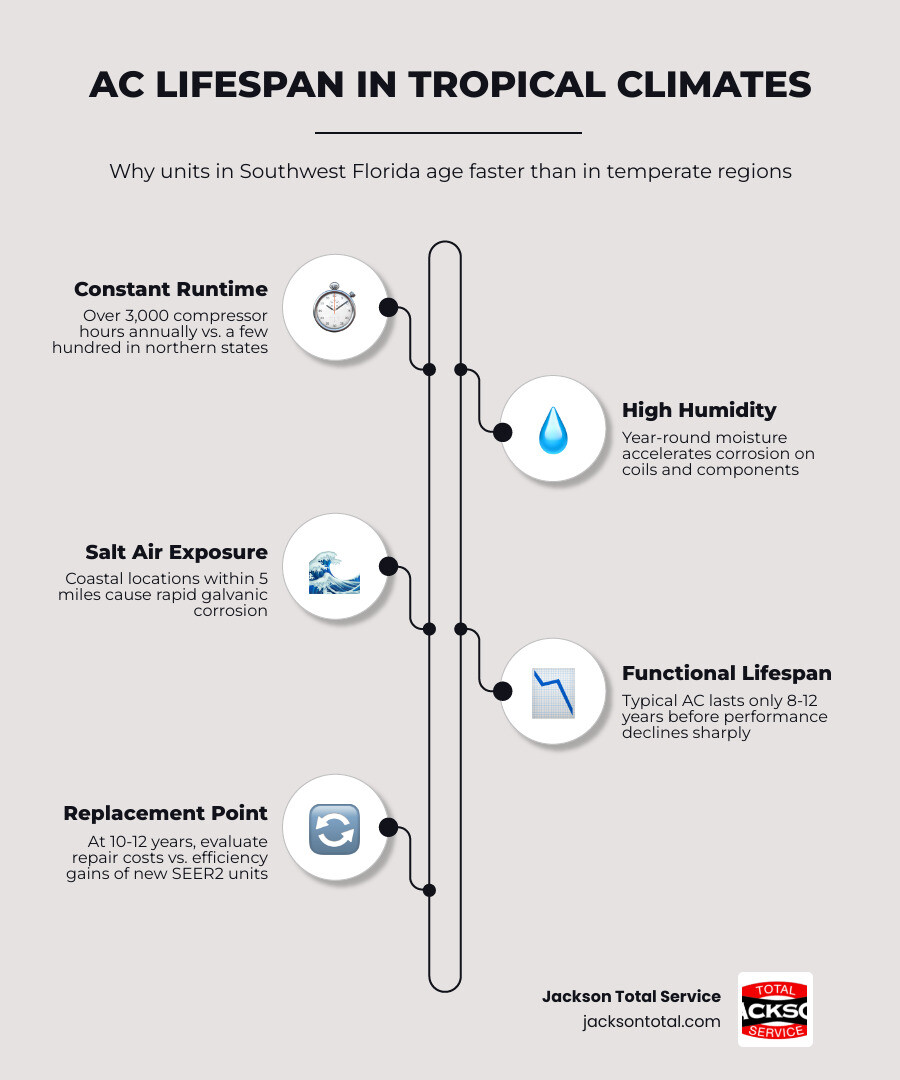
In temperate climates, an AC unit might last 15 to 20 years. But in Southwest Florida, the combination of year-round heat, relentless humidity, and salt air means most systems are functionally spent between 8 and 12 years. Florida AC units log over 3,000 compressor hours every single year — compared to just a few hundred in cooler northern states. That kind of constant runtime ages a system fast, in the same way a car driven 50,000 miles a year wears out far sooner than one driven 5,000.
If your AC is approaching or past that 10-year mark, it is worth knowing exactly what to watch for, when repairs stop making financial sense, and what a modern replacement can do for your comfort and energy bills.
The Lifespan of an AC Unit in Tropical Climates
When we talk about the lifespan of an air conditioner, geography is everything. If you moved to Lee County or Collier County from a northern state, you might expect your cooling system to quietly do its job for nearly two decades. Unfortunately, our subtropical paradise has other plans.
In Southwest Florida, we do not have a standard “cooling season.” Instead, we have a brief period of slightly milder weather followed by months of intense, unrelenting heat. This means our systems do not get a winter break. Because they operate almost year-round, local cooling systems age at double the speed of their northern counterparts.
While a system in a temperate climate might only log 500 run-hours a year, our home comfort systems are running for 3,000 hours or more annually. This constant cycling puts immense pressure on the compressor, fan motors, and electrical components. By the time a local air conditioner celebrates its tenth birthday, it has logged the equivalent of 25 to 30 years of northern usage. That is why we consider a 12-year-old system in Naples or Fort Myers to be a senior citizen.
To understand why our local weather demands so much from your system, check out our guide on The Heat Is On: Why Tropical Cooling Is a Full-Time Job for Your HVAC.
Why Tropical Climates Accelerate AC Aging
It is not just the sheer number of operational hours that wears down our air conditioners; it is the harsh environment itself. Tropical climates present a perfect storm of environmental stressors that actively degrade HVAC machinery.
The Threat of Salt Air and Galvanic Corrosion
If you live within five miles of the Gulf of Mexico — whether that is right on the beach in Marco Island, Sanibel Island, or slightly inland in Naples — your AC is exposed to airborne salt. This salt acts as a persistent corrosive agent.
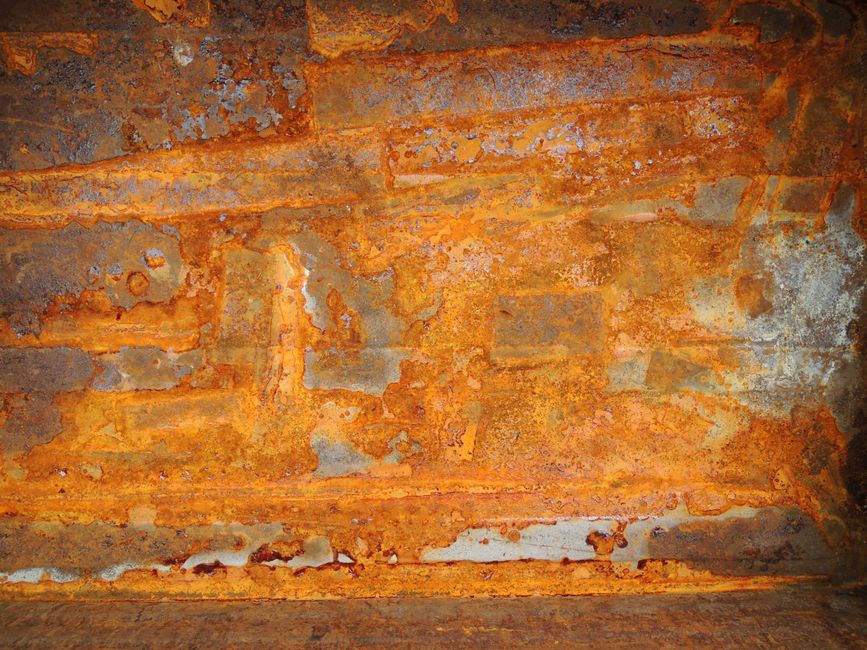
When salt air settles on your outdoor condenser unit, it triggers galvanic corrosion. This is a destructive electrochemical process that occurs when different metals, such as copper tubing and aluminum fins, come into contact in a moist, salty environment. The aluminum fins eventually weaken, turn to dust, and fall away. Without these fins, the condenser cannot release heat efficiently, forcing the compressor to work much harder and run much hotter, which dramatically shortens its life.
High Humidity and Constant Moisture
Relative humidity in Southwest Florida regularly hovers above 80% to 90%. This means your air conditioner is working twice as hard. An AC is not just a temperature controller; it is also a giant dehumidifier.
To cool your home, the system must first pull moisture out of the air. This moisture condenses on the indoor evaporator coil and drains away. When humidity is high, the system must run longer cycles just to lower the indoor humidity to a comfortable level. This constant moisture also leaves the system vulnerable to rust, biological growth, and clogged drain lines.
For a deeper look into how our local moisture levels impact your system, read about Why Your AC Needs Extra Love in Humid Climates.
Determining How Old Is Too Old for an AC in Tropical Climates
So, how do you know if your cooling system is simply showing its age or if it is officially “too old”?
One of the clearest indicators of an aging system is efficiency loss. Over a decade of heavy use in our climate, an air conditioner can lose up to half of its original operating efficiency. This means you could be paying twice as much to get the same level of cooling as you did when the unit was new.
To help you evaluate your system, we have compiled a comparison of normal wear-and-tear versus the warning signs of a system nearing the end of its life:
| Symptom | Normal Wear & Tear (Keep Repairing) | Warning Signs of Aging (Consider Replacement) |
|---|---|---|
| Energy Bills | Small, seasonal fluctuations | Steady, unexplained increases month-over-month |
| Cooling Performance | Slow cooling on the hottest afternoons | Inconsistent temperatures and warm air blowing from vents |
| Humidity Control | Indoor air feels dry and comfortable | Indoor air feels muggy, sticky, or clammy |
| Repair Frequency | One minor repair every few years | Multiple service calls in a single season |
| System Noises | Normal humming and clicking at startup | Loud rattling, grinding, squealing, or “hard starting” |
If you are noticing that your home is consistently humid even when the AC is running, your system may no longer have the capacity to manage the latent heat load. To learn more about how humidity affects your system’s health, consult The Ultimate Guide to Humidity and AC Maintenance Needs.
Performance Signs of How Old Is Too Old for an AC in Tropical Climates
When an air conditioner is reaching the end of its functional life in a tropical climate, it will start dropping performance hints.
- Inconsistent Cooling and Hot Spots: You might notice that your living room is freezing while your bedroom remains uncomfortably warm. This often indicates that the compressor or blower motor is losing its efficiency and can no longer distribute air evenly.
- Frequent Short-Cycling: If your system turns on and off every few minutes, it is short-cycling. This places incredible mechanical strain on the compressor and fan motors, and it prevents the system from running long enough to remove humidity.
- Strange and Loud Noises: Squealing, grinding, or banging noises are clear signs of mechanical failure. A loud shuttering or clicking sound when the outdoor unit kicks on — known as “hard starting” — is a major warning sign that your compressor is struggling.
- Indoor Air Quality and Mold Issues: Because an aging AC cannot manage humidity effectively, indoor moisture levels rise. In Southwest Florida, high indoor humidity is an open invitation for mold and mildew to grow inside your ductwork, on your walls, or around your registers.
If you suspect mold is already becoming an issue in your home, check out The Ultimate Guide to Mold-Free Air Conditioning for helpful prevention strategies.
Financial Indicators of How Old Is Too Old for an AC in Tropical Climates
At some point, keeping an old air conditioner running becomes a game of expensive financial whack-a-mole. To determine whether a repair is a smart investment or a waste of money, we recommend using two classic industry guidelines.
The 50% Rule
The 50% Rule is straightforward: if the cost of a single repair exceeds 50% of the actual value of your current system, you should replace it. Investing significant money into a system that is already near the end of its lifespan rarely makes sense, as other aging components are likely to fail shortly after.
The $5,000 Rule
The $5,000 Rule is a simple mathematical formula that factors in the age of your system.
$$\text{Age of the System (Years)} \times \text{Cost of the Repair} = \text{Score}$$
If the resulting score is over $5,000, replacement is generally the smarter financial move. If the score is under $5,000, repairing the unit is usually reasonable.
Let’s look at two examples:
- Scenario A: You have an 8-year-old system that needs a minor repair.
$$8 \text{ years} \times \$300 \text{ repair} = 2,400$$
Since 2,400 is well under 5,000, repairing the unit is a sensible choice. - Scenario B: You have a 12-year-old system that needs a compressor replacement.
$$12 \text{ years} \times \$600 \text{ repair} = 7,200$$
Since 7,200 is far above 5,000, investing that money into a brand-new, high-efficiency system is the much smarter long-term decision.
For a detailed breakdown of these financial frameworks, read The Complete Guide to the $5000 Dollar Rule and explore our decision-making resource, Should You Fix It or Nix It: Your AC Decision Guide.
The Impact of Refrigerant Phase-Outs and Modern SEER2 Standards
Environmental regulations and technological advancements also play a major role in deciding when to retire an older air conditioner.
The Refrigerant Transition
If your air conditioner was installed before 2010, it almost certainly uses R-22 refrigerant. The EPA completely phased out the production and import of R-22 in 2020. Today, finding R-22 to service a leak is incredibly difficult and exceptionally expensive. If an older R-22 system develops a major refrigerant leak, replacement is virtually always the only practical option.
Furthermore, even systems using R-410A (the standard refrigerant for units built between 2010 and 2024) are seeing phased-down production as the industry transitions to newer, more environmentally friendly refrigerants. This means maintaining older R-410A systems will become increasingly expensive over the next several years.
The Power of SEER2 Efficiency
In 2023, the Department of Energy implemented strict new SEER2 (Seasonal Energy Efficiency Ratio 2) standards. Today’s entry-level cooling systems are significantly more efficient than the premium models of a decade ago.
Upgrading from an old 10 SEER system to a modern 16 or 18 SEER2 system can slash your monthly cooling bills by 30% to 50%. Many modern systems also feature variable-speed compressors. Unlike older systems that run at either 100% capacity or 0%, variable-speed systems run continuously at lower, ultra-efficient speeds. This provides incredibly precise temperature control and unmatched humidity removal.
To see if upgrading your system makes financial sense for your household, read Is High SEER Worth the Cash or Just Blowing Smoke? and consult our AC Repair vs Replacement Cost Guide for Smart Homeowners.
Proactive Maintenance to Extend Your AC Lifespan
While our climate is undeniably tough on machinery, you do not have to sit back and watch your system degrade. A proactive maintenance strategy can easily add two to three years of reliable service to your air conditioner.
The Homeowner’s Monthly Checklist
- Change Air Filters Every 30 Days: In Southwest Florida, dusty or pollen-filled air can quickly clog filters. A dirty filter restricts airflow, forcing your system to work harder and run hotter, which can lead to premature compressor failure.
- Keep the Outdoor Unit Clear: Ensure there is at least two feet of clear space around your outdoor condenser. Trim back any tropical landscaping, vines, or shrubs that might block airflow.
- Flush the Condensate Drain Line: Algae and mold thrive in warm, dark drain lines. Flushing your drain line monthly with a cup of distilled white vinegar can prevent clogs and water damage.
Professional Maintenance is Key
Having your system professionally serviced at least once — or ideally twice — a year is essential. A professional technician can check refrigerant levels, clean the evaporator and condenser coils, inspect electrical contacts, and install dedicated surge protectors to shield your system from lightning strikes and storm-related power surges.
Planning your system evaluation or replacement during our “shoulder seasons” (March to April or October to November) is also a smart strategy. It is much easier to make an informed decision when you are not dealing with a mid-August cooling emergency.
To establish the perfect maintenance routine for your home, take a look at Don’t Sweat It: A Guide to Florida AC Maintenance Frequency.
Frequently Asked Questions about Tropical AC Lifespan
How long does an AC last near the coast in Florida?
Due to salt air corrosion, air conditioning systems located within five miles of the Gulf of Mexico typically last between 7 and 12 years. This is roughly three to five years less than identical systems installed further inland. To maximize a coastal unit’s lifespan, we highly recommend applying specialized anti-corrosive coil coatings and rinsing the outdoor condenser coils with fresh water once a month to remove salt buildup.
Does turning off the AC when I am away extend its life?
No, turning your system completely off during hot humid days actually shortens its lifespan and can damage your home. When the AC is off, indoor relative humidity can quickly spike above 65%, creating an ideal environment for mold growth, warping wood floors, and damaging drywall. Furthermore, when you return and turn the system back on, it will experience immense mechanical strain as it runs continuously for hours to bring the temperature and humidity back down. Instead, we recommend setting your thermostat to 78°F when you are away.
What features should I look for in a tropical replacement AC?
When replacing an air conditioner in Southwest Florida, look for systems that feature:
- Anti-corrosive coil coatings to protect against salt air.
- A variable-speed compressor for superior humidity removal and energy efficiency.
- A high SEER2 rating to help keep your monthly energy bills manageable.
- Proper system sizing verified by a professional Manual J load calculation, ensuring the unit is not oversized (which causes short-cycling and high humidity) or undersized (which causes constant running).
Conclusion
Deciding whether your air conditioner is too old is all about balancing age, performance, and financial reality. While our beautiful tropical climate is tough on cooling systems, being proactive about maintenance and knowing the warning signs of failure can save you from a summer breakdown.
When you need trusted advice, professional maintenance, or a seamless system replacement, we are here to help. At Jackson Total Service, we have been keeping homes throughout Southwest Florida comfortable since 1964. As a family-owned business, we provide comprehensive HVAC, plumbing, and electrical services in Naples, Bonita Springs, Estero, Marco Island, and the surrounding communities. Our skilled, licensed technicians are ready to handle all of your home comfort needs in one place, backed by our commitment to fast, dependable service.
If you want to ensure your cooling system is ready to handle our year-round heat, schedule an evaluation today on our Jackson Total Service Air Conditioning Services page.