



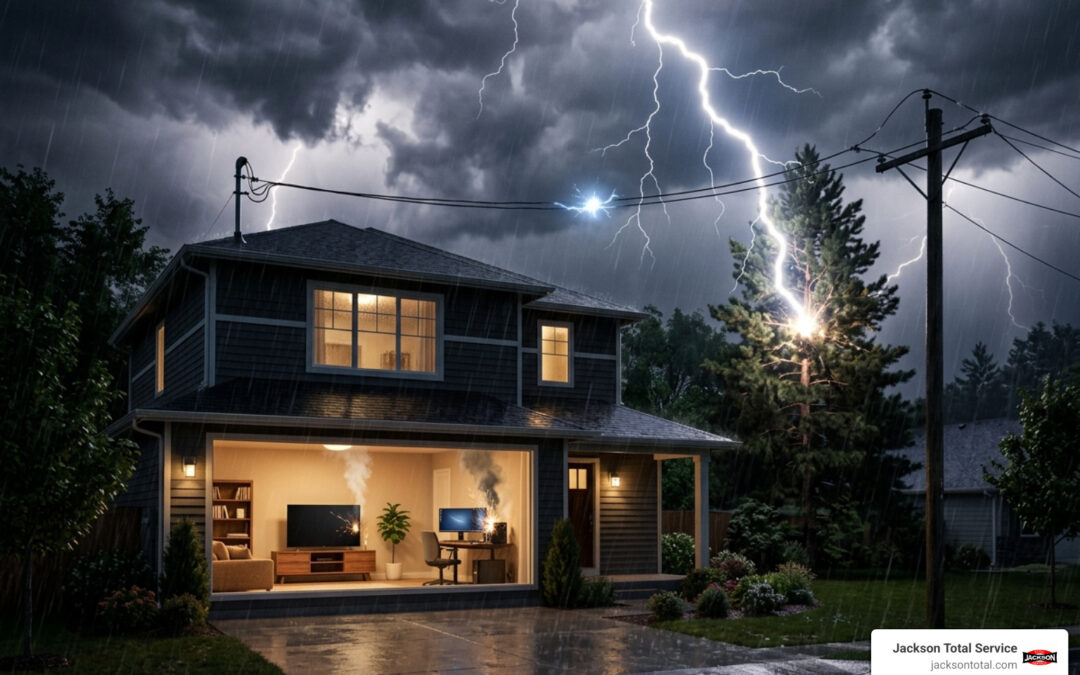
The Real Threat Inside Every Southwest Florida Thunderstorm
Understanding how lightning damages your home electronics and appliances starts with one surprising fact: your house doesn’t have to take a direct hit for the damage to be devastating. Lightning strikes the United States roughly 25 million times every year, and a single bolt can carry up to 300 million volts, 30,000 amps of current, and generate heat reaching 50,000 degrees Fahrenheit — hot enough to vaporize metal and melt wiring hidden inside your walls. Here in Southwest Florida, where Naples and the surrounding Lee and Collier County communities see some of the highest lightning frequency in the entire country, this is not a rare-weather concern. It’s a regular summer reality.
Most homeowners picture lightning damage as a dramatic scorched wall or a blown fuse. The truth is far more subtle — and far more expensive. A strike can hit a nearby power line, travel through your utility connection, and silently fry the control board inside your refrigerator, HVAC system, or smart home hub without leaving a single visible mark. In 2022 alone, U.S. homeowners filed more than 62,000 lightning-related insurance claims totaling $950 million in losses. And that figure doesn’t account for the damage that never gets traced back to the storm at all.
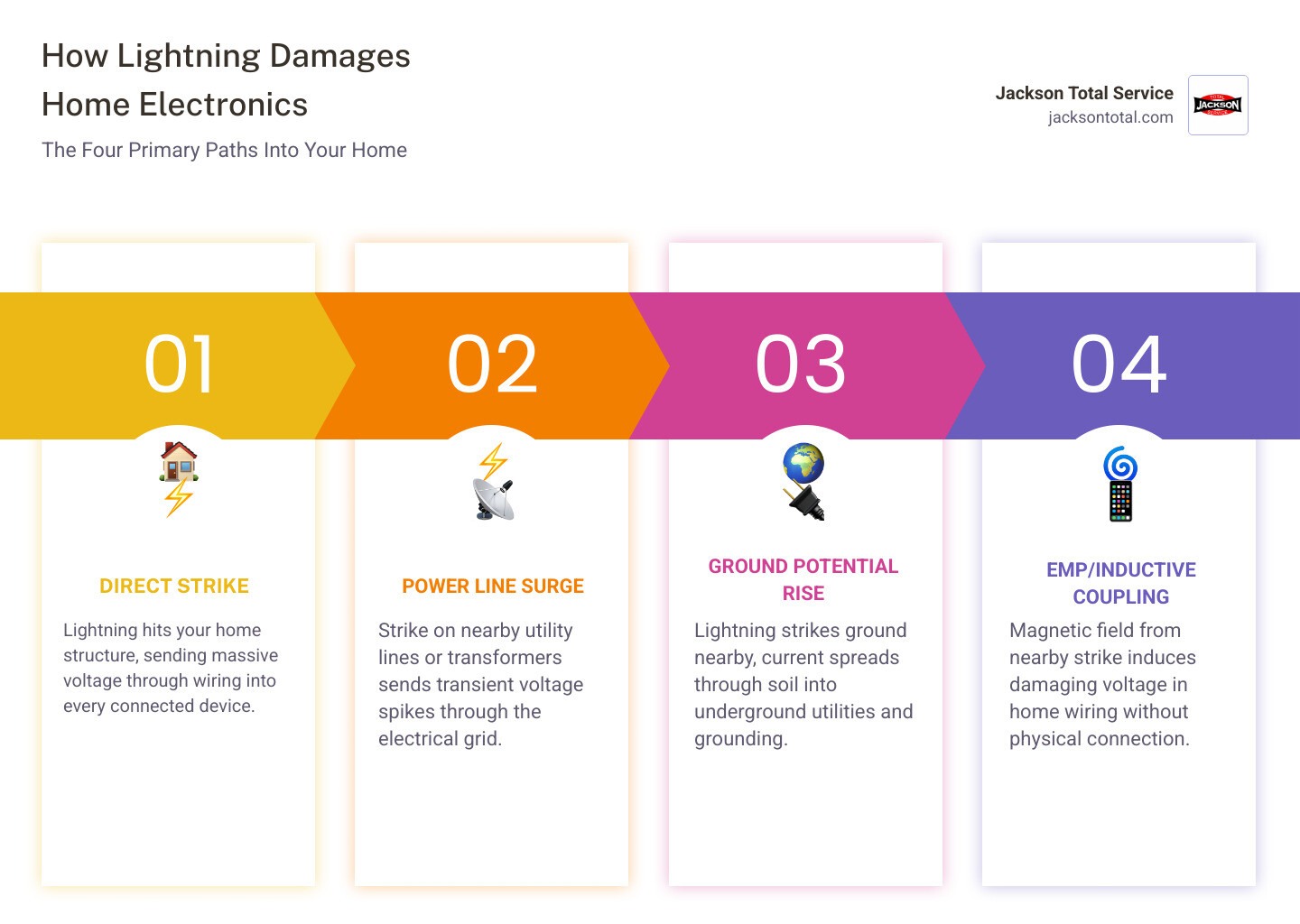
Here’s a quick breakdown of the primary ways lightning reaches and destroys home electronics:
How lightning damages home electronics and appliances — at a glance:
- Direct strike — Lightning hits your home structure, sending massive voltage through wiring and into every connected device
- Indirect strike via power lines — Lightning hits a nearby transformer or utility line, sending a surge through your electrical grid connection
- Ground potential rise — Lightning hits the ground near your home, and current spreads through the soil and enters through underground utility lines or your grounding system
- Electromagnetic pulse (EMP) / inductive coupling — A nearby strike generates a powerful magnetic field that induces voltage in your home’s wiring and circuits — even without any physical connection
- Entry through non-electrical lines — Surges travel into your home via cable TV, phone lines, or internet coaxial lines, targeting modems, routers, and smart devices
The damage can be immediate and obvious, or it can be slow and invisible — weakening semiconductors and wiring insulation over weeks until something finally fails. Either way, the cost adds up fast.
How Lightning Damages Your Home Electronics and Appliances Without a Direct Strike
It is a common misconception among Naples homeowners that if their roof wasn’t hit, their electronics are safe. In reality, direct strikes to a structure only account for about 3% to 5% of all lightning-related incidents. The vast majority of damage is caused by indirect strikes. When lightning hits a nearby power line or a transformer, it creates a massive transient voltage spike that travels through the utility grid and into your home’s electrical panel.
This sudden influx of energy is thousands of times higher than the standard 120 volts your appliances are designed to handle. This is what really happens to your electronics during a power surge: the excess electricity forces its way through circuits, creating heat that can melt microscopic pathways on silicon chips. Because Southwest Florida’s electrical grid is frequently stressed by our intense storm seasons, why Florida homeowners shouldn’t play electrical roulette becomes clear—without protection, your entire home inventory is at the mercy of the next afternoon thunderstorm.
Understanding how lightning damages your home electronics and appliances through inductive coupling
Lightning can also damage your devices “wirelessly.” Every lightning bolt creates a powerful Electromagnetic Pulse (EMP). This pulse generates a rapidly changing magnetic field that can induce high-voltage currents in any conductive material within range—including the wiring inside your walls and the delicate circuits inside your phone or laptop.
This process, known as inductive coupling, means that even if a device is turned off or not physically connected to a wall outlet, the internal components can still be fried. We often see cases where a smartphone sitting on a nightstand has its motherboard destroyed because a nearby strike induced a voltage spike directly into the device’s internal traces.

The danger of ground reference potential charge
Another “invisible” path is ground potential rise. When lightning hits the ground near your home in Cape Coral or Fort Myers, the electricity doesn’t just disappear; it spreads through the soil. If your home’s grounding system or underground utility lines (like water pipes or internet cables) are in the path of this current, the electricity will follow the path of least resistance into your house.
This creates a voltage differential across your electrical system, leading to disruptive currents that can overwhelm your main electrical panel. To keep your family safe from these ground-level threats, it is vital to stay grounded with these essential electrical safety tips, ensuring your home’s bonding and grounding systems are up to modern standards.
The Most Vulnerable Components in Your Southwest Florida Home
In 2026, our homes are smarter and more interconnected than ever, but that convenience comes with a trade-off: increased vulnerability. Modern electronics rely on integrated circuits and microprocessors that are incredibly sensitive to even minor voltage fluctuations.
The most at-risk items in your home include:
- Smart Home Hubs and Automation: These systems often act as a single point of failure. A surge to the main hub can simultaneously disable your security cameras, smart locks, and lighting controls.
- Networking Equipment: Routers and modems are frequently targeted because they are connected to both power lines and external data lines (coaxial or fiber), giving surges two ways to enter.
- HVAC Systems: Your air conditioner’s control board is a sophisticated computer. A surge can destroy the board or weaken the compressor motor, leading to a breakdown in the middle of a Naples July.
- Modern Kitchen Appliances: Today’s refrigerators and dishwashers use electronic control boards rather than mechanical timers, making them far more susceptible to electrical stress.
Maintaining an awareness of the ultimate guide to electrical panel capacity and modern home safety is essential for ensuring your home can handle the sophisticated loads of these devices while remaining protected from external surges.
Why modern appliances are more sensitive in 2026
As technology advances, the components inside our gadgets get smaller. While this allows for faster processing and sleeker designs, it also reduces the microscopic spacing between insulators. In older appliances, an insulator might have been thick enough to withstand a 400-volt spike; in a modern silicon chip, that same insulator might be punctured by as little as 40 to 60 volts.
This low voltage tolerance is the shocking truth about why your home needs surge protection. When lightning induces a surge, it doesn’t just “blow” a device; it often creates microscopic “arcing scars” on semiconductors, which leads to cumulative degradation.
Immediate and Hidden Signs of Lightning-Induced Electrical Damage
Sometimes lightning damage is obvious—you hear a loud “pop,” see a spark, or smell ozone. However, much of the damage is “latent,” meaning the device seems fine today but fails three weeks later because its internal components were weakened.
Common signs of lightning damage include:
- Burning Odors: A metallic or “burning plastic” smell near outlets or appliances.
- Flickering Lights: This can indicate that the surge damaged your home’s wiring insulation or loosened connections.
- Tripped Breakers: If a breaker trips during a storm and won’t reset, do not force it. This is a major safety warning.
- “Ghosting” on Outlets: Dark, soot-like deposits around the plug holes indicate that electrical arcing occurred.
- Erratic Performance: A microwave that resets its clock randomly or a TV with new lines across the screen.
Following a storm, it’s a good idea to review don’t get zapped with these home safety tips to ensure you are checking the right areas of your home for hidden hazards.
Identifying latent failure in your HVAC and kitchen appliances
HVAC systems and refrigerators are particularly prone to latent failure. A surge might not kill the motor immediately, but it can damage the winding insulation. This causes the motor to run hotter than usual, eventually triggering the thermal protector or causing the motor to seize up entirely weeks after the storm has passed. If your AC starts making a new humming sound or struggles to start up, it may be suffering from post-storm electrical stress.
Why a Power Strip Isn’t Enough to Stop a 300-Million-Volt Strike
Many homeowners rely on a $20 power strip from a big-box store and assume they are protected. This is a dangerous mistake. Most basic power strips are designed to handle small “ripples” in the power grid, not the massive “tsunami” of energy a lightning strike produces.
Why a power strip is not a surge protector comes down to the Joule rating and the Metal Oxide Varistors (MOVs) inside. A standard strip might have a rating of 500 Joules, while a high-end entertainment center protector might offer 2,000. However, a nearby lightning strike can easily exceed these limits, vaporizing the “fallen soldier” MOVs inside the strip and leaving your equipment wide open to the rest of the surge.
| Feature | Point-of-Use Power Strip | Whole-Home Surge Protection |
|---|---|---|
| Installation | Plug into outlet | Main Electrical Panel |
| Protection Level | 500 – 2,000 Joules | 40,000 – 80,000+ Amps |
| Coverage | Only devices plugged into it | Every outlet and hardwired appliance |
| Reaction Time | < 1 nanosecond | < 1 nanosecond |
| Durability | One-time use for major surges | Built for multiple significant events |
Preventive measures for how lightning damages your home electronics and appliances
The most effective strategy is a “layered defense.” This starts with a Type 1 or Type 2 surge protector installed directly at your main electrical panel. These devices act as a gateway, diverting the vast majority of an incoming surge safely into the ground before it ever enters your home’s branch circuits.
Understanding the inner workings of whole-house surge protection explained helps homeowners see why this is a necessary investment in Southwest Florida. When combined with high-quality point-of-use protectors for sensitive electronics like computers and home theaters, you create a robust shield that can handle both external lightning strikes and internal surges caused by your AC or refrigerator cycling on and off.
Steps to Take After a Southwest Florida Storm and Proving Insurance Claims
If a major storm has just rolled through Naples or Fort Myers, don’t wait for things to stop working to take action. Conduct a quick “walk-through” of your home:
- Check the Panel: Look for tripped breakers.
- Test GFCI Outlets: Push the “test” and “reset” buttons on outlets in your kitchen and bathrooms.
- Sniff for Odors: Check near your major appliances and the electrical panel for any scorched smells.
- Monitor Your AC: Ensure your HVAC system is cycling normally and maintaining the set temperature.
How to verify lightning damage for your provider
Proving lightning damage to an insurance company can be challenging because the damage is often internal. To build a strong claim:
- Document Everything: Take photos of any visible marks, soot, or melted plugs.
- Keep the Evidence: Do not throw away fried electronics until the adjuster has seen them.
- Get a Lightning Verification Report: These reports use weather data to confirm a strike occurred within a specific radius of your home at a specific time, providing 99% accuracy.
- Professional Assessment: Have a licensed electrician from Jackson Total Service perform a functional test. We can provide the professional documentation required to prove that the failure was caused by a surge rather than “normal wear and tear.”
Frequently Asked Questions about Lightning Damage
Can unplugged or turned-off devices still be damaged by lightning?
Yes. As mentioned earlier, the Electromagnetic Pulse (EMP) from a nearby strike can induce voltage directly into the internal circuits of a device, even if it isn’t plugged in. Additionally, lightning can travel through non-electrical paths like your cable TV line or even conductive metal plumbing pipes.
How effective are surge protectors against a direct lightning strike?
No surge protector can guarantee 100% protection against a direct hit to your home’s structure. The sheer volume of energy in a 300-million-volt bolt can “jump” across or bypass protection devices. For direct strikes, structural lightning protection—like lightning rods and air terminals—is required to safely guide the energy to the earth. However, for the 95% of incidents involving indirect strikes, a whole-home surge protector is extremely effective.
What are the best preventive measures to protect my home?
The “Gold Standard” of protection is a three-pronged approach:
- Install Whole-Home Surge Protection at the main electrical panel.
- Ensure Proper Grounding and Bonding of your home’s electrical system.
- Use High-Quality Point-of-Use Protectors for your most sensitive gear (computers, TVs, and smart hubs).
Conclusion
Living in Southwest Florida means enjoying beautiful beaches and sunny days, but it also means dealing with some of the most intense lightning activity in the world. Understanding how lightning damages your home electronics and appliances is the first step toward preventing a catastrophic financial loss. From the “silent killer” of latent semiconductor failure to the immediate threat of a massive grid surge, the risks to your home are constant during the rainy season.
At Jackson Total Service, we’ve been helping our neighbors in Naples, Fort Myers, and throughout Lee and Collier counties stay safe and comfortable since 1964. We provide comprehensive electrical inspections to identify hidden damage and install professional-grade whole-home surge protection systems that offer peace of mind when the clouds turn dark.
Don’t wait until you’re smelling smoke or staring at a blank TV screen. Schedule your professional surge protection installation today and protect your home from the power of the storm.