


What Every Southwest Florida Homeowner Needs to Know
Knowing how to protect your AC during a hurricane could be the difference between cooling off the moment power returns and facing a costly system replacement. In Southwest Florida — where Naples, Bonita Springs, and Estero sit squarely in hurricane country — your air conditioner is one of the most expensive and vulnerable systems in your home. And yet, it’s one of the most overlooked items on any storm prep checklist.
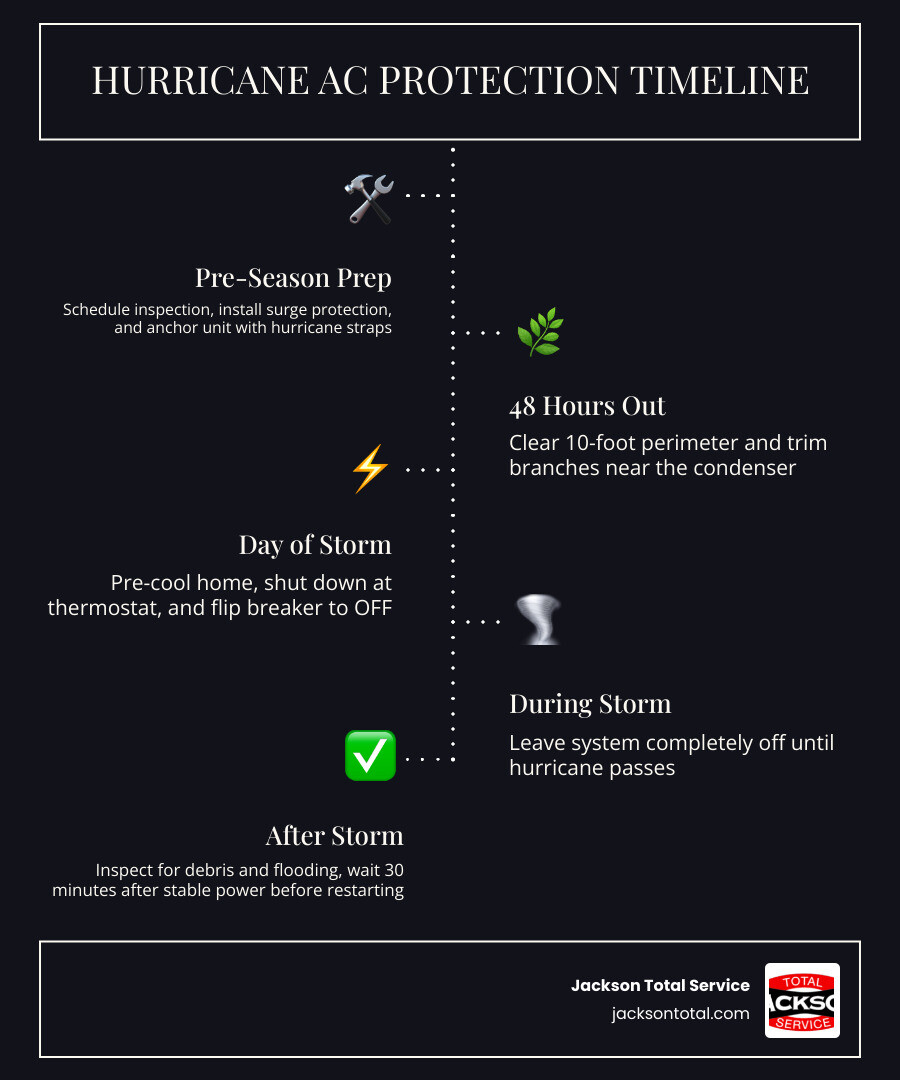
Here’s a quick overview of the key steps to protect your AC before, during, and after a hurricane:
- Before the season: Schedule a professional inspection, install surge protection, and anchor the outdoor unit with hurricane straps.
- 48 hours out: Clear a 10-foot perimeter around the condenser and trim nearby branches.
- Day of the storm: Pre-cool your home, then shut the system down at the thermostat and flip the breaker to OFF.
- During the storm: Leave the system off. Do not run your AC while a hurricane is active.
- After the storm: Visually inspect the unit for debris, flooding, or damage before restoring power. Wait at least 30 minutes after stable power returns before restarting.
- If in doubt: Call a licensed HVAC technician before turning the system back on.
The stakes are real. Hurricane Ian knocked out power for over 2.1 million Floridians, and lightning-induced power surges are the number one cause of post-storm AC failure across the Florida peninsula. Debris alone accounts for 60% of avoidable AC damage during high-wind events. Add in storm surge, salt-air corrosion, and the mold that can take hold in your ductwork within just 48 hours of a power loss, and it’s clear that your AC needs a dedicated storm plan — not an afterthought.
The good news? Most of this damage is preventable. This guide walks you through exactly what to do before, during, and after a hurricane to keep your system safe and your home cool when it matters most.
Related content about how to protect your ac during a hurricane:
Why Hurricanes Pose a Severe Threat to Your AC System
To truly understand how to protect your ac during a hurricane, you must first understand the specific physical and electrical forces working against your system during a major storm. In Southwest Florida, our air conditioners work harder than almost anywhere else in the country. We rely on them year-round, which is why The Heat Is On: Why Tropical Cooling Is a Full-Time Job for Your HVAC. However, this constant operation makes them highly vulnerable when extreme weather strikes.
During a hurricane, your AC system faces a triple threat of wind, water, and electrical volatility:
- Wind-Driven Debris: Category 1 hurricanes bring winds starting at 74 mph, while major storms can exceed 150 mph. At these speeds, loose roof shingles, tree branches, and even unsecure patio furniture become high-velocity projectiles. Debris causes 60% of avoidable AC damage during high-wind events, often puncturing delicate aluminum condenser coils, bending fan blades, or crushing the outdoor housing entirely.
- Storm Surge and Flooding: While outdoor condenser units are designed to withstand heavy downpours, they are not submersible. If storm surge or localized flooding submerges the electrical components, fan motor, or compressor, the unit is highly likely to short-circuit and suffer catastrophic failure if energized.
- Salt-Air Corrosion: In coastal areas like Naples, Bonita Springs, and Sanibel Island, hurricanes drive massive amounts of salt-laden moisture miles inland. This wind-driven salt mist coats the interior components of your condenser, accelerating galvanic corrosion and compressing years of wear and tear into a single 24-hour period.
- Lightning Strikes and Power Surges: Florida leads the nation in lightning strikes, and the average number of lightning strikes in Florida is a staggering 3,500 per day. When a hurricane approaches, lightning activity peaks. A nearby strike can send tens of thousands of volts traveling through utility lines directly into your home, frying your AC’s sensitive control boards, capacitors, and compressor motors instantly.
- Grid Instability: As the storm knocks down power lines, the electrical grid experiences rapid “brownouts” and voltage fluctuations. If your AC remains on, these rapid power interruptions force the compressor to cycle on and off under high pressure, which can destroy the motor in minutes.
Phase 1: Pre-Season Preparation and System Hardening
The best time to learn how to protect your ac during a hurricane is months before a storm ever appears on the radar. In Southwest Florida, the Atlantic hurricane season runs from June 1 through November 30. Hardening your system in the spring ensures that when a storm warning is issued, you only have to focus on minor, immediate tasks rather than major structural modifications.
A key step in this hardening process is scheduling a pre-season tune-up. During this visit, we inspect all electrical connections, tighten loose components, and ensure your system is running at peak efficiency. This is crucial because 25% to 40% of the energy used for cooling is wasted in dirty, poorly maintained systems. A well-maintained system is far more resilient to the stresses of storm season.
To get your home fully prepped, check out our guide on How to Get Your Home Systems Ready for Storm Season and review our Air Conditioning Maintenance in Estero FL: Your Essential Service Checklist to ensure no detail is overlooked.
Physical Safeguards: How to Protect Your AC During a Hurricane from Debris
Physical protection starts at the base of your outdoor unit. To prevent high winds from shifting or tipping your condenser, it must be properly anchored:
- Hurricane Straps and Anchors: Modern Florida building codes require outdoor condensers to be bolted directly to a concrete pad or heavy-duty hurricane pad. We highly recommend installing heavy-gauge galvanized steel or aluminum hurricane straps. These straps wrap over the top of the unit and anchor securely into the concrete slab, keeping the unit upright in winds up to 150 mph.
- Elevating the Unit: If you live in a low-lying, flood-prone neighborhood in Cape Coral, Fort Myers Beach, or Naples, consider having your condenser elevated on a hurricane-rated stand. Raising the unit 12 to 24 inches above the base flood elevation can save it from being ruined by minor storm surges or standing water.
- Clearing the Perimeter: Maintain a strict 10-foot debris-free radius around your outdoor condenser. Trim back overhanging tree branches, prune nearby shrubs, and remove any loose items from your yard. During a storm, a single loose branch or plastic lawn chair can act as a wrecking ball against your AC coils. For more details on securing your property, read our article on How to Batten Down the Hatches for Your Home Systems.
Electrical Safety: How to Protect Your AC During a Hurricane from Power Surges
Electrical protection is your second line of defense, and it is arguably the most critical. While physical debris causes visible damage, lightning-induced surges are the #1 cause of post-storm AC failure in the Florida peninsula.
- Dedicated HVAC Surge Protectors: Many homeowners assume that a standard whole-house surge protector at the main electrical panel is enough. However, these panels often fail to fully block the massive 240-volt electrical spikes that travel through AC disconnect lines. Installing a dedicated, heavy-duty HVAC surge protector directly at the outdoor electrical disconnect box provides a vital buffer. These devices are specifically designed to withstand Southwest Florida’s high humidity and divert extreme voltage spikes away from your compressor and control board.
- Checking Electrical Connections: Over time, heat and humidity can cause electrical connections within your AC to loosen or corrode. During a pre-season inspection, our technicians tighten these connections and inspect the contactor and capacitors. A weak or marginal capacitor might survive normal daily operation but will almost certainly fail when subjected to the electrical stress of a post-storm power restoration. For a complete breakdown of electrical storm safety, refer to our Cheat Sheet to Electrical Safety Preparation Before Hurricanes.
Phase 2: The 24-Hour Countdown and Safe Shutdown Procedures
When a hurricane watch or warning is officially issued for Southwest Florida, it is time to transition from long-term hardening to your immediate, 24-hour checklist.
This phase is all about timing. You want to keep your home as comfortable as possible for as long as possible while ensuring that your system is completely powered down before the outer wind bands and lightning arrive. For a comprehensive look at managing your home’s major systems during this critical window, see The Ultimate Guide to AC, Plumbing & Electrical in Southwest Florida.
Why You Must Turn Off Your AC Before a Hurricane
We cannot stress this enough: never run your air conditioner during a hurricane.
Even if your electricity is still running, you must shut the system down. As the storm approaches, wind-driven rain can force water into the electrical cabinet of your condenser. More importantly, the power grid will begin to struggle. Rapid voltage fluctuations, brownouts, and brief power flickers force your AC compressor to cycle on and off repeatedly under immense pressure. This rapid cycling can overheat the compressor motor, damage the start capacitor, or fry the control board.
Furthermore, simply turning the thermostat to “OFF” is not enough to protect your system. A close-proximity lightning strike can easily jump across the open contacts of a thermostat relay. To truly isolate your system, you must shut off power at both the thermostat and the main circuit breaker.
The Pre-Cooling Technique to Keep Your Home Comfortable
To avoid sitting in a hot, humid house the moment you turn off your AC, utilize the “pre-cooling” technique. This turns your home into a temporary thermal battery:
- 12 to 24 Hours Before Landfall: Lower your thermostat 3 to 5 degrees cooler than your normal setting (aim for 68°F to 70°F if your system can comfortably handle it). Do this while you still have stable grid power.
- Seal the Envelope: Close all interior doors, windows, blinds, and heavy curtains. This helps trap the cold air inside and blocks radiant heat from the sun.
- Run Dehumidifiers: If you have portable dehumidifiers, run them on high to pull as much moisture out of the air as possible. Lower humidity levels make the air feel significantly cooler and delay the growth of mold.
- The Final Shutdown: Once the outer bands of the storm arrive—or when winds reach tropical-storm-force (39 mph)—turn off the AC at the thermostat, and then flip the dedicated HVAC circuit breaker in your main electrical panel to the “OFF” position.
Phase 3: Post-Storm Recovery and Safely Restarting Your AC
Once the storm passes and the blue skies return, your immediate instinct will likely be to turn the AC back on to escape the stifling Florida humidity. However, rushing to restart your system without a proper inspection can cause severe, irreversible damage to your equipment.
Southwest Florida’s humid climate is incredibly unforgiving. Because indoor air can be 2 to 5 times more polluted than outdoor air, and mold can start growing in SWFL ductwork within 48 hours of a power loss when humidity levels exceed 60%, managing your indoor climate post-storm is a race against time. To understand why moisture control is so critical in our region, read Why Your AC Needs Extra Love in Humid Climates and The Ultimate Guide to Humidity and AC Maintenance Needs.
Step-by-Step Restart Protocol After the Storm Passes
Before you flip the breaker back on, follow this strict step-by-step restart protocol:
- Perform a Visual Inspection: Walk outside and inspect the condenser. Is it still upright and level on its pad? Are the refrigerant lines and electrical conduits intact, or do they look bent, cracked, or disconnected?
- Check for Debris: Look inside the top fan grille. Are there tree branches, leaves, or roof shingles trapped inside the unit? Clear any visible obstructions.
- Check for Standing Water: Is there standing water around the base of the unit? If the water level rose high enough to submerge any part of the bottom of the cabinet, do not turn it on.
- Remove Any Covers: If you secured a temporary cover or plywood over the unit before the storm, remove it completely. Running an AC with a cover on will burn out the compressor within minutes due to restricted airflow.
- Wait for Stable Power: Once utility power is restored to your neighborhood, do not turn your AC on immediately. The grid is often highly unstable during the first hour of restoration. Wait at least 30 to 60 minutes for the utility voltage to stabilize.
- Flip the Breaker First: Switch the main AC circuit breaker back to the “ON” position.
- Wait 5 Minutes at the Thermostat: After restoring breaker power, wait 5 minutes before turning the thermostat to “COOL.” This allows the internal delay timers in your modern digital thermostat and outdoor control board to complete their safety cycles and equalize system pressure.
When to Call a Professional Technician for Post-Hurricane AC Repair
If your inspection reveals any of the following warning signs, leave the breaker off and call us immediately for a professional inspection:
- The Unit Was Submerged: If your AC was exposed to rising floodwaters, it must be professionally cleaned, dried, and electrically tested. Salt water is highly conductive and corrosive; turning on a salt-water-damaged unit will instantly destroy its electrical components.
- Unusual Noises: If you hear a loud buzzing, clicking, or screeching sound when the unit attempts to start, shut it off immediately. This often indicates a damaged compressor, a failing capacitor, or debris striking the fan blades.
- The Smell of Smoke: If you detect a burnt, electrical, or metallic smoke smell coming from either the outdoor condenser or the indoor air handler, shut down the power at the breaker box immediately.
- Refrigerant Leaks: If you notice pooling oil around the base of the unit or hear a hissing sound, your refrigerant lines may have cracked when the unit shifted during the storm.
| Flooding Type | Primary Risks to AC System | Required Actions Before Restart |
|---|---|---|
| Freshwater Flooding (Heavy Rain/Runoff) | Silt accumulation, electrical shorts, fan motor damage, rusted cabinet base. | Complete visual inspection, clear mud/silt from coils, verify electrical compartments are completely dry. |
| Saltwater Flooding (Storm Surge) | Rapid galvanic corrosion of aluminum fins, ruined electrical wiring, destroyed compressor terminals. | Do not turn on. Must be professionally flushed with fresh water, dried, and electrically tested by a technician. |
Frequently Asked Questions About How to Protect Your AC During a Hurricane
Can I run my AC on a backup generator after a storm?
You can, but only under very specific conditions. A standard 3-ton residential AC unit typically pulls 16 to 18 running amps, but it requires a massive startup surge of 80 to 100 amps (equivalent to 15,000 to 18,000 watts) just to get the compressor running.
Approximately 90% of portable generators (which typically output 5,000 to 7,500 watts) cannot handle this initial startup load and will stall or damage your AC motor. You should only run your central AC on a properly sized whole-home standby generator (usually 10,000 to 24,000 watts) that has been professionally integrated into your home with a manual or automatic transfer switch.
Should I cover my AC unit during a hurricane?
This is a highly debated topic among homeowners, but the general rule is simple: never cover your AC while it is running.
If you choose to cover your unit to protect it from falling debris right before a storm, use a manufacturer-approved, breathable high-wind cover or secure a piece of plywood over the top of the unit using heavy-duty ratchet straps. Do not wrap the unit in tight plastic wrap or tarps, as this traps humidity inside the cabinet and accelerates rust and corrosion. Any cover must be removed immediately after the storm passes and before you turn the system back on.
Does homeowners insurance cover hurricane damage to my AC?
In most cases, standard homeowners insurance policies cover physical damage to permanently installed AC systems caused by wind, falling trees, or flying debris, subject to your policy’s hurricane deductible (which often ranges from 2% to 5% of your home’s total insured value).
However, damage caused by rising floodwaters or storm surge is typically excluded from standard policies and requires separate flood insurance through the National Flood Insurance Program (NFIP). Always take date-stamped photos of your outdoor unit and its manufacturer data plate before and after a storm to provide clear documentation for any potential claims.
Conclusion
Living in Southwest Florida means enjoying our beautiful tropical climate, but it also means respecting the power of storm season. Taking the time to learn how to protect your ac during a hurricane is an investment in your home’s safety, your family’s comfort, and your financial peace of mind. From installing surge protection and securing physical anchors to executing a disciplined shutdown and restart protocol, these simple steps can save you from a major post-storm headache.
At Jackson Total Service, we’ve been helping our neighbors in Naples, Bonita Springs, Estero, Cape Coral, and across Lee and Collier counties protect their homes since 1964. As a family-owned company with over six decades of local experience, we provide complete, one-stop home comfort solutions across HVAC, plumbing, and electrical services.
Don’t wait for a storm to appear on the radar to think about your air conditioner. To ensure your system is fully prepared to handle whatever Southwest Florida’s climate throws its way, consider joining our preventive care program. Learn more about how we keep your system running smoothly year-round by reading Stop Worrying and Love the Maintenance Agreement and exploring our Maintenance Agreements page.
Need a pre-season inspection, a dedicated HVAC surge protector installation, or post-storm emergency support? Contact us today or visit our Jackson Total Service Home Comfort Services page to schedule a visit with our licensed, trusted technicians. We are here to keep you safe, cool, and comfortable—before, during, and after the storm.