



Why Understanding How Smart Home Technology Integrates With Your Electrical System Matters
Understanding how smart home technology integrates with your electrical system is simpler than most homeowners expect — and more important than ever.
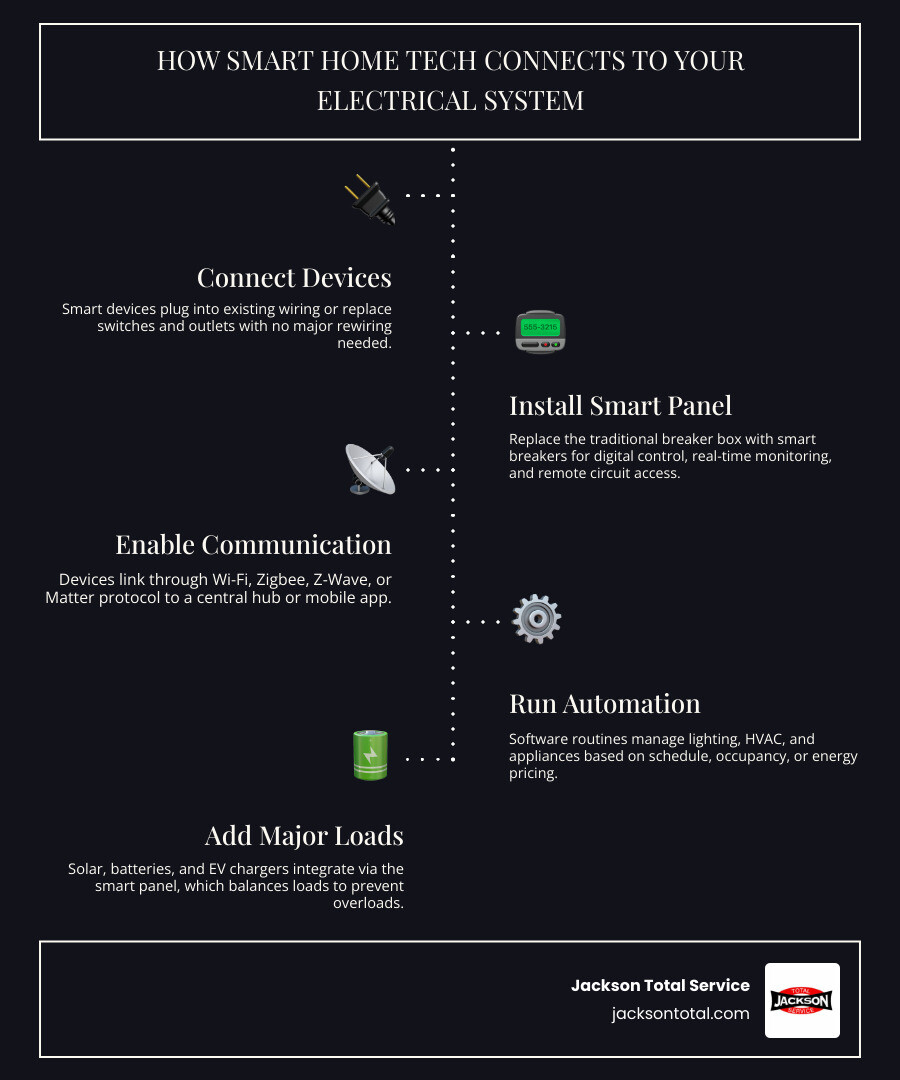
Here’s a quick overview of how it works:
- Smart devices connect to your existing wiring — most plug in or replace standard switches and outlets without major rewiring.
- A smart panel (or smart breakers) replaces your traditional breaker box — adding digital control, real-time monitoring, and remote access by circuit.
- Devices communicate over Wi-Fi, Zigbee, Z-Wave, or the Matter protocol — linking to a central hub or app on your phone.
- Automation routines and load management run through software — adjusting lighting, HVAC, and appliances based on your schedule, occupancy, or energy prices.
- Larger upgrades like solar, batteries, and EV chargers connect through the smart panel — which balances loads automatically to avoid overloading your system.
For Southwest Florida homeowners — where summer heat, humidity, and storm season put constant pressure on home electrical systems — getting this foundation right isn’t just about convenience. It’s about safety, efficiency, and protecting every connected device in your home.
Smart homes used to be a novelty. In 2026, they’re quickly becoming the standard. And it all starts with your electrical system.
Understanding the Foundation: How Smart Home Technology Integrates With Your Electrical System

A smart home electrical system is still a real electrical system first. It has the same basics as a traditional home: service wires, a main panel, breakers, branch circuits, outlets, switches, and grounding. The difference is that smart technology adds a digital layer on top of that foundation.
That digital layer can include:
- Smart switches and dimmers
- Smart outlets and plugs
- Smart thermostats
- Smart breakers
- Smart electrical panels or load centers
- Sensors, hubs, and mobile apps
- Voice assistant and automation platform integration
In a traditional setup, electricity flows through the panel and circuits, but the panel cannot tell you much beyond whether a breaker has tripped. In a smart setup, parts of the system can report what is happening in real time. You can often see energy use by circuit, receive alerts, create schedules, and remotely control selected loads.
This is why smart homes are not just about gadgets. They are about turning your electrical system into a more visible, manageable, and responsive part of the home.
For many homeowners, the first step is making sure the electrical backbone is ready. If your panel is outdated or undersized, it can limit what your home can safely support. Our guide to electrical panel capacity and modern home safety is a helpful place to start.
The Role of Smart Breakers and Outlets
Smart breakers and smart outlets are where the integration starts to feel practical.
A smart breaker does the usual breaker job of protecting a circuit, but it may also add features like:
- Circuit-level energy monitoring
- Remote on/off control
- Scheduled operation
- Alerts for unusual behavior
- Load shedding during backup power events
That circuit-level visibility matters. Instead of guessing why your bill jumped, you may be able to see whether the HVAC, water heater, pool equipment, or EV charger is driving demand.
Smart outlets and smart switches work farther downstream. They typically let you:
- Turn devices on and off remotely
- Set schedules
- Automate lights and small appliances
- Monitor some plug loads
- Coordinate scenes like “goodnight” or “away”
Some of these upgrades are simple. A smart plug is usually easy to add. A hardwired outlet, switch, breaker, or panel is another story. Once line-voltage wiring or panel work is involved, this is licensed electrician territory.
Communication Protocols and Hubs
A smart device still needs a way to “talk” to the rest of the home. That communication usually happens through:
- Wi-Fi
- Zigbee
- Z-Wave
- Matter
Wi-Fi devices connect directly to your home network, which is convenient but can crowd a weaker network if you keep adding devices. Zigbee and Z-Wave usually rely on a hub and are designed for low-power device communication. Matter is newer and aims to improve compatibility between brands and ecosystems.
For homeowners, the big takeaway is simple: the electrical wiring delivers power, and the communication protocol delivers control.
That is why successful integration depends on both:
- Safe, code-compliant electrical infrastructure
- Reliable network connectivity and device compatibility
If one side is weak, the smart home feels less smart and more like a part-time employee with no coffee.
Essential Infrastructure: Preparing Your Home for Automation
Before installing a house full of connected devices, we recommend looking at the fundamentals:
- Panel capacity
- Available breaker spaces
- Wiring condition
- Grounding and bonding
- Surge protection
- Neutral conductors in switch boxes
- AFCI and GFCI compatibility where required
Many homes can support at least some smart upgrades right away. Others need preparation first. This is especially true in older homes, where original wiring and panels may not have been designed for today’s always-on devices, connected appliances, and higher overall load.
Research shows that many homes built before the 1990s may lack the grounding, neutral wiring, or capacity needed for modern smart upgrades. If your home is older, this does not mean you cannot add smart technology. It simply means the path may need to be more strategic.
A proper assessment can reveal whether your home needs a panel upgrade, dedicated circuits, wiring improvements, or additional protection before moving forward. If you own an older property, our article Is Your Vintage Home a Fire Hazard? explains why old wiring should never be treated as “probably fine.”
Planning how smart home technology integrates with your electrical system in older homes
Older homes are often fully compatible with smart upgrades, but they can present a few common challenges.
One big one is the missing neutral wire at switch boxes. Many smart switches need a neutral to power their electronics, and older switch loops often do not have one. In those cases, you may need:
- A different style of smart control
- Rewiring at the switch location
- A professionally selected compatible device
Other issues may include:
- 100-amp service that is too limited for expanding loads
- Outdated breaker boxes or fuse panels
- Two-prong outlets or poor grounding
- Incompatible dimmers
- Nuisance trips on older or mismatched AFCI/GFCI setups
This matters in Southwest Florida, where homes often run air conditioning hard for long stretches and may also add pool equipment, dehumidification, surge protection, generators, or EV charging. An older panel that is already full is not going to magically become roomy because your app is attractive.
If you notice frequent tripping, flickering lights, buzzing from the panel, rust, heat discoloration, or burning smells, stop thinking about smart features and start with safety. Our article Why Florida Homeowners Shouldn’t Play Electrical Roulette covers those warning signs in more detail.
Comparing Traditional vs. Smart Electrical Panels
| Feature | Traditional Panel | Smart Panel |
|---|---|---|
| Core job | Distributes electricity and trips during faults | Distributes electricity and adds digital monitoring/control |
| Monitoring | Little to no real-time visibility | Real-time whole-home and often circuit-level data |
| Remote control | None | Often allows app-based control of selected circuits |
| Alerts | Manual discovery only | Can send notifications for faults or unusual use |
| Load management | Fixed, manual | Can prioritize, shed, or schedule loads |
| Solar and battery integration | Limited visibility | Better coordination with solar, batteries, and backup systems |
| EV charger support | May require larger service upgrade | Can help manage charging loads more intelligently |
| Installation approach | Standard replacement or repair | Full replacement or selected smart components |
| Homeowner insight | Very limited | Detailed usage trends and demand peaks |
The biggest difference is visibility. Traditional panels protect the home, but they do not explain much. Smart panels turn the panel into an information hub. For some homeowners, that means convenience. For others, it means avoiding overloads, planning future upgrades, and understanding where the power is actually going.
Maximizing Efficiency with Smart Panels and Load Management
One of the most useful parts of smart electrical integration is load management.
Load management means your system can monitor how much power the house is using and make decisions based on preset priorities. That might include:
- Delaying EV charging until late night hours
- Cycling water heating during peak demand
- Prioritizing air conditioning over less essential loads
- Reducing noncritical loads when battery backup is active
- Avoiding a main breaker trip when several large appliances try to run at once
This is especially useful in homes adding high-demand equipment. Modern life is electric-hungry. HVAC systems, heat pumps, ovens, dryers, pool systems, and EV chargers all want their share at the same time. Smart panels can help coordinate those loads instead of letting everything rush the buffet at once.
Smart monitoring also supports energy savings. Research shows smart home devices can reduce household energy use by up to 30% when used well. That does not happen by magic. It happens because homeowners can finally see patterns and automate smarter behavior, such as:
- Turning lights off when rooms are empty
- Adjusting cooling schedules by occupancy
- Running certain loads outside peak utility periods
- Catching devices that are running longer than they should
Our article Stay Grounded with These Essential Electrical Safety Tips is a good companion read because efficiency should never come at the expense of safety.
Integration with Solar and Battery Storage
Smart panels are especially helpful when solar and battery storage enter the picture.
Instead of treating solar, batteries, and household loads as separate systems, a smart panel can help coordinate them. Depending on the setup, it may:
- Track solar production and household consumption in real time
- Prioritize which circuits get backup power
- Shift certain loads to periods of solar production
- Reduce demand peaks to make stored battery power last longer
- Support participation in grid-demand or utility-response programs where available
Backup prioritization is one of the biggest real-world benefits. During an outage, many homeowners do not need every circuit powered. They need the right circuits powered: refrigeration, internet, select lighting, medical devices, and cooling equipment where possible. Smart controls can help protect battery runtime by automatically shedding less essential loads.
Managing High-Demand Loads
High-demand loads deserve special planning, especially in our climate.
In Southwest Florida, HVAC is usually the heavyweight champion of summer electrical use. Add in dehumidification, pool pumps, electric water heating, or an EV charger, and your panel may be doing cardio whether it likes it or not.
Smart technology helps by making those loads more manageable:
- Smart thermostats can reduce unnecessary runtime and improve scheduling
- Occupancy-based routines can cut waste in unoccupied zones
- Smart panels can coordinate charging and large appliances
- Circuit monitoring can reveal inefficient equipment
- Humidity-focused controls can improve comfort without overcooling
This is where smart homes become practical, not flashy. The goal is not to turn your house into a spaceship. The goal is to keep it comfortable, efficient, and safe without overloading the electrical system.
Protecting Sensitive Electronics in the Smart Era
The more connected your home becomes, the more important surge protection becomes.
Smart homes rely on sensitive electronics: control boards, hubs, routers, thermostats, TVs, appliances, cameras, garage controls, and panel electronics. These components do not like voltage spikes. In storm-prone Southwest Florida, that risk is not theoretical.
Whole-home surge protection helps defend the electrical system from incoming surges and voltage fluctuations before they travel deeper into your home. That is why we strongly recommend learning more about why your home needs surge protection and what really happens to your electronics during a power surge.
Research also highlights another important point: smart devices create a cumulative load. Even if each one uses only a little power, dozens of always-on devices add up. That is one more reason monitoring, panel assessment, and surge protection matter.
Layered Defense Strategies
The best protection is layered protection.
That usually includes:
- A whole-home surge protector at the main panel
- Proper grounding and bonding
- Correctly installed AFCI and GFCI protection where required
- Surge-compatible protection strategies where appropriate
- Point-of-use protection for especially sensitive electronics
- Battery backup for critical networking or security devices
A power strip alone is not the same thing as whole-home surge protection. If you want the short version, it is this: the strip may help at the device, but it does not protect the home at the service entrance. Our related resources explain this well:
- The Inner Workings of Whole House Surge Protection Explained
- Why a Power Strip Is Not a Surge Protector
For smart homes, layered defense is not overkill. It is basic common sense with a Wi-Fi password.
Frequently Asked Questions About Smart Electrical Integration
Can smart home technology be added to older homes?
Yes, in most cases it can.
Older homes may need a little more planning, but smart upgrades are often very achievable. We usually start with an infrastructure assessment to look at:
- Panel condition and capacity
- Grounding
- Presence of neutral wires
- Condition of existing circuits
- Room for future loads
Some homes can start small with smart lighting, plugs, or thermostats. Others may need wiring updates or a panel upgrade first. The right path depends on the house, not just the shopping cart.
If you are unsure where to begin, focus on safe, scalable upgrades. Our guide on electrical safety tips is a smart first read.
How smart home technology integrates with your electrical system for energy savings?
It saves energy by combining visibility with automation.
Smart systems can monitor usage in real time, identify peak demand, and automate changes based on schedule, occupancy, or conditions in the home. That can include:
- Dimming or shutting off lights automatically
- Adjusting thermostat settings when nobody is home
- Scheduling appliances outside high-demand times
- Tracking unusual energy use at the circuit level
- Reducing standby waste
Research shows smart home devices can reduce household energy consumption by up to 30%. Results vary, of course, but the principle is solid: when you know what is using power and can automate better choices, waste tends to drop.
What happens to smart systems during a power outage?
Most smart systems stop active operation during an outage unless they are on battery backup, but that does not mean everything is lost.
In many systems:
- Saved settings remain in memory
- Devices reconnect when power returns
- Standard breaker protection still works
- Critical devices may stay online if backed up
- Smart panels can prioritize essential circuits if paired with battery storage
During an internet outage, many smart devices lose app control but still retain basic electrical function. During a utility outage, devices without backup power turn off like any other powered equipment. That is why critical loads should be planned intentionally, especially for security, refrigeration, communications, and health-related needs.
Conclusion
Smart home integration works best when the technology and the electrical system are planned together. Smart switches, outlets, thermostats, breakers, and panels can bring real convenience, better energy awareness, and improved control, but they all depend on a safe electrical foundation.
For homeowners in Naples, Fort Myers, Estero, Bonita Springs, Marco Island, and surrounding Lee and Collier County communities, that means thinking beyond the device itself. Panel capacity, surge protection, grounding, circuit design, and future load planning all matter if you want a smart home that is actually reliable.
At Jackson Total Service, we have served Southwest Florida since 1964, and we understand that home technology should make life easier, not more complicated. If you are ready to start small or plan a larger upgrade, our licensed technicians can help you evaluate your system, improve safety, and create a practical roadmap for smarter living. Learn more about our Electrical Services.
And if your “smart home plan” currently consists of yelling at a lamp, we can help with that too.