


Is It Time? How to Know When Should You Replace Your AC in the Tropics
Knowing when should you replace your AC in the tropics can be the difference between a planned, stress-free upgrade and a sweaty emergency breakdown in the middle of a Southwest Florida summer. In a region like Naples, Bonita Springs, or Marco Island — where your air conditioner runs nearly year-round against relentless heat, thick humidity, and salt-laden coastal air — the wear on your system is simply not comparable to anywhere else in the country.
Here is a quick-reference summary to help you decide:
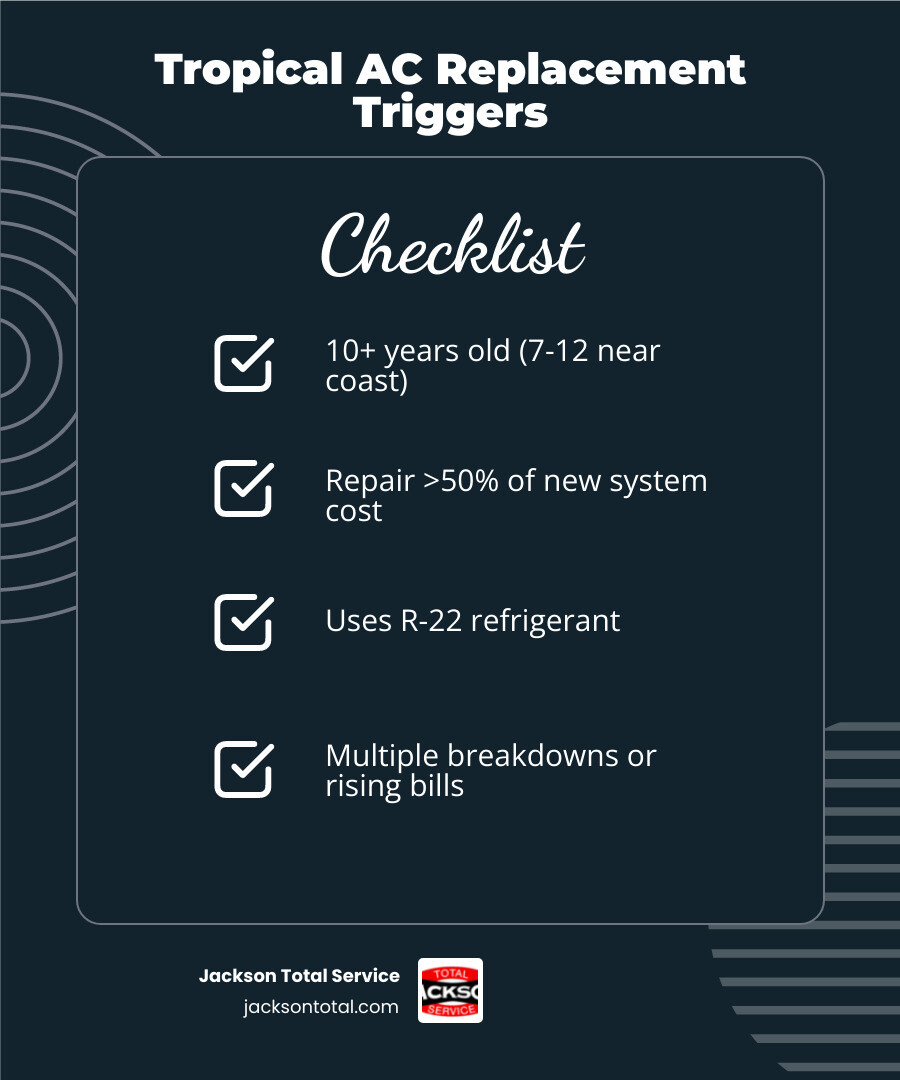
Replace your AC in a tropical climate if any of the following apply:
- Your unit is 10 or more years old (7-12 years if you live near the coast)
- Repair costs exceed 50% of the price of a new system
- The unit’s age multiplied by the repair cost exceeds $5,000 (the $5,000 Rule)
- Your system uses R-22 refrigerant (phased out by the EPA in 2020)
- You have experienced multiple breakdowns in a single season
- Your home feels humid or clammy even when the AC is running
- Your energy bills keep climbing without a clear reason
- There is visible corrosion or physical deterioration on the outdoor unit
While the national average lifespan for an AC unit is 15 to 20 years, tropical climates like Southwest Florida cut that figure nearly in half. Most systems here last just 8 to 12 years — and coastal homes close to the Gulf can see that number drop even further due to accelerated salt-air corrosion.
The good news is that recognizing the right moment to replace, rather than repair, saves you money, improves comfort, and keeps your home protected before the heat of peak season hits.
Basic when should you replace your ac in the tropics vocab:
Understanding AC Lifespan: How Long Do Systems Last in the Tropics?
When discussing air conditioning lifespans, location is everything. If you speak to a homeowner in Michigan or Maine, they might casually mention that their air conditioner is approaching its 20th birthday and still humming along just fine. In Southwest Florida, however, a 10-year-old air conditioner is already considered a senior citizen.
The stark difference in lifespan comes down to simple math and operational runtime. In temperate northern climates, an AC unit might only run for three to five months out of the year, logging a modest 500 to 1,000 hours of compressor runtime annually.
In tropical and subtropical regions like Fort Myers, Cape Coral, and Estero, our air conditioners are on duty for 10 to 11 months of the year — often running 10 to 14 hours a day during the sweltering peak of summer. By the time a local Southwest Florida AC unit celebrates its tenth anniversary, it has logged more operational hours than a northern system would in 25 or 30 years.
To help put this into perspective, we can look at how tropical wear and tear compares directly to temperate regions:
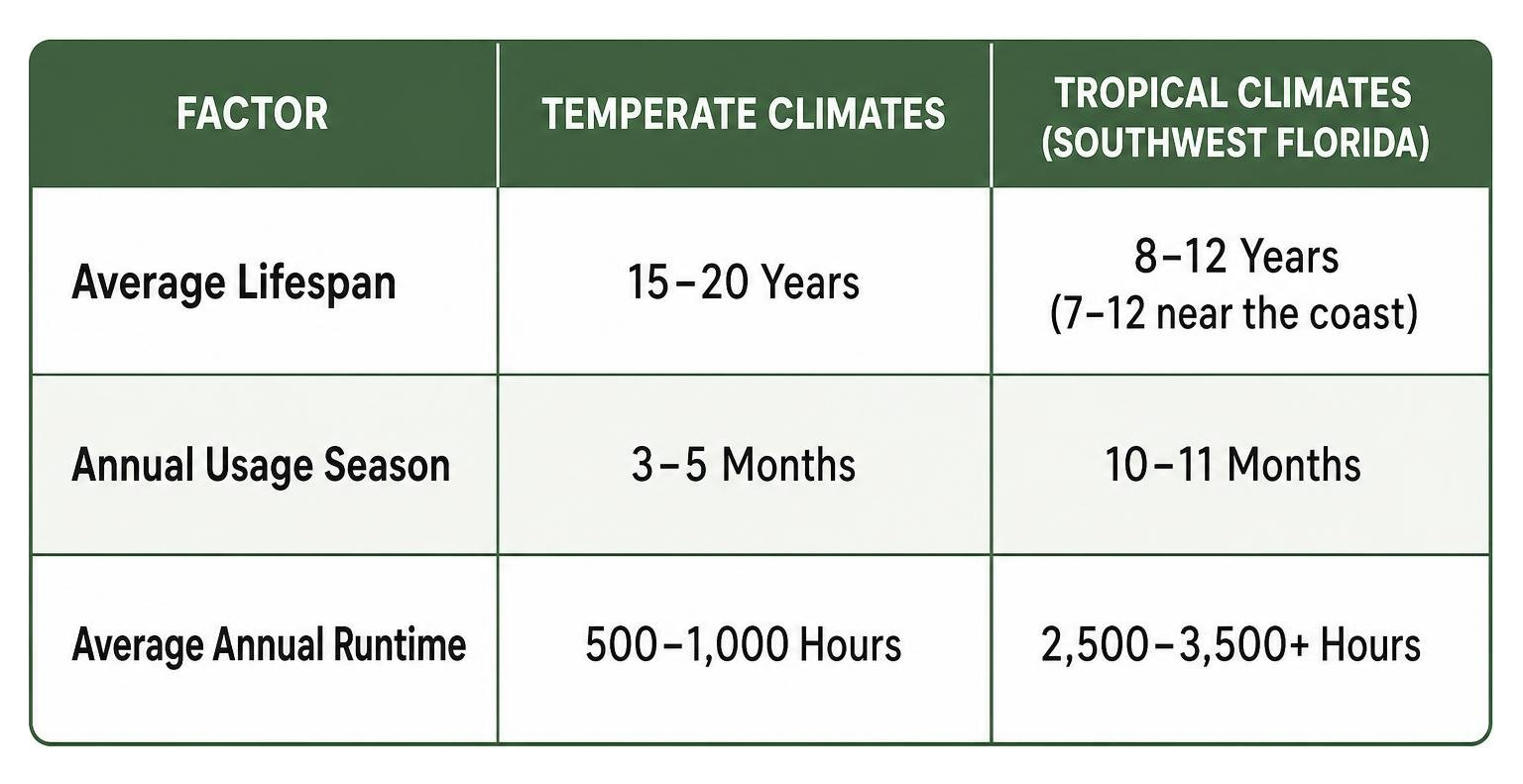
| Factor | Temperate Climates | Tropical Climates (Southwest Florida) |
|---|---|---|
| Average Lifespan | 15–20 Years | 8–12 Years (7–12 near the coast) |
| Annual Usage Season | 3–5 Months | 10–11 Months |
| Average Annual Runtime | 500–1,000 Hours | 2,500–3,500+ Hours |
| Primary Environmental Stressors | Winter freezing (when idle) | Constant heat, 75-80% average humidity, salt air |
| Efficiency Loss Over Time | Gradual (minimal over 10 years) | Up to 50% decline after 10 years without strict care |
Because of this intense operational load, understanding How Old Is Too Old for an AC in Tropical Climates? is critical for budgeting and home comfort planning. When your system is forced to work overtime every single day, mechanical parts wear out faster, electrical connections degrade, and the overall efficiency of the system drops. For a deeper look at why our local weather demands so much from our cooling systems, check out The Heat Is On: Why Tropical Cooling Is a Full-Time Job for Your HVAC.
Environmental Stressors Unique to Southwest Florida
It isn’t just the constant runtime that ages air conditioners prematurely in our corner of Florida; it is the highly corrosive environment.
Southwest Florida boasts some of the most beautiful coastlines in the world, from Sanibel Island and Fort Myers Beach down to Marco Island. However, that gorgeous Gulf breeze carries microscopic salt particles. Coastal salt-air corrosion is a leading cause of premature AC failure. When salt spray lands on the outdoor condenser unit, it triggers chemical reactions that cause “coil rot.” The thin aluminum fins on the outdoor coil become brittle, turn to dust, and break away, while the copper refrigerant lines develop microscopic pinhole leaks.
Furthermore, our relative humidity regularly hovers between 75% and 80%. This moisture acts as a catalyst for rust and corrosion, while also forcing your indoor evaporator coil to work twice as hard. Your AC doesn’t just cool the air; it must remove gallons of water from your indoor air every day to keep you comfortable. This relentless dehumidification process places immense physical stress on the blower motor and drainage system. To find out how to combat these moisture-rich challenges, read about Why Your AC Needs Extra Love in Humid Climates.
When Should You Replace Your AC in the Tropics? Key Warning Signs

Because a sudden system failure in July can quickly turn your home into an oven, it is best to recognize the warning signs of a failing system before it breaks down completely. Keep an eye out for these key indicators:
- Weak or Insufficient Airflow: If your vents are blowing lukewarm air or the airflow feels noticeably weaker than it used to, your compressor or blower motor may be on its last legs.
- Frequent, Costly Breakdowns: If you find yourself calling for repairs multiple times in a single season to fix capacitors, contactors, or fan motors, you are likely playing an expensive game of “whack-a-mole.”
- Unexplained Spikes in Energy Bills: As air conditioners age in tropical conditions, they lose efficiency. An unexplained 15% to 25% increase in your monthly electric bill often indicates that the compressor is drawing excess power to achieve the same cooling effect.
- Inability to Manage Indoor Humidity: When your home starts feeling “sticky” or clammy, or you notice musty odors and mold growth near your vents, your system is no longer effectively dehumidifying.
- Excessive Noise or Vibration: Grinding, squealing, or loud rattling noises from either the indoor handler or the outdoor condenser indicate serious mechanical wear.
To help you weigh your options when these signs begin to appear, we have put together a comprehensive resource: Should You Fix It or Nix It: Your AC Decision Guide.
The Financial Decision: Applying the $5,000 Rule and 50% Rule
When faced with a broken air conditioner, how do you mathematically decide whether to repair or replace it? HVAC professionals rely on two trusted rules of thumb: the 50% Rule and the $5,000 Rule.
The 50% Rule
This rule is simple: if the cost of a single repair exceeds 50% of the value of a brand-new, high-efficiency replacement system, you should always replace it. Investing half the cost of a new, warrantied system into an aging unit that will likely break down again soon is rarely a wise financial move.
The $5,000 Rule
To apply this rule, multiply the age of your air conditioning system (in years) by the written repair estimate. If the total is greater than $5,000, replacement is the smarter long-term investment. If the total is less than $5,000, repairing the unit is usually reasonable.
Let’s look at two real-world examples:
- Scenario A (Repair): You have an 8-year-old system in Cape Coral that needs a minor repair, such as a new capacitor or a fan motor. The repair estimate is $300.
- Calculation: 8 (years old) × $300 (repair cost) = $2,400.
- Decision: Since $2,400 is well below the $5,000 threshold, repairing the system is the sensible choice.
- Scenario B (Replace): You have a 12-year-old system in Naples that has a failed compressor or a severely corroded evaporator coil. The repair estimate is $600.
- Calculation: 12 (years old) × $600 (repair cost) = $7,200.
- Decision: Because $7,200 far exceeds the $5,000 limit, replacing the system is the smarter financial move. You will gain a brand-new warranty, lower utility bills, and peace of mind.
For a detailed breakdown of these financial calculations, consult our AC Repair vs. Replacement Cost Guide for Smart Homeowners.
The R-22 Refrigerant Phase-Out Factor
If your current air conditioner was installed before 2010, there is a very high probability that it operates on R-22 refrigerant (commonly known as Freon). R-22 is an ozone-depleting substance that was completely phased out by the EPA. Since January 2020, the production and import of R-22 has been entirely illegal in the United States.
If your older system develops a refrigerant leak today, servicing it is incredibly difficult and expensive. Because the remaining supply of R-22 is extremely scarce, recharging an old system can cost astronomical amounts.
Furthermore, R-22 systems are inherently inefficient compared to modern standards. If your pre-2010 system has a leak or a compressor failure, trying to patch it up is a temporary, expensive band-aid. Upgrading to a modern system that uses environmentally friendly refrigerants (like R-410A or the newer R-454B) is the only logical path forward.
Choosing the Right Technology for a Tropical AC Replacement
When the time comes to purchase a new air conditioner, you shouldn’t simply buy the exact same model you had before. HVAC technology has advanced significantly, offering features specifically engineered to handle tropical climates more efficiently.
SEER2 Ratings
In 2023, the Department of Energy implemented new, more rigorous testing standards called SEER2 (Seasonal Energy Efficiency Ratio 2). In Florida, the minimum allowable efficiency rating for a new split-system AC is 14.3 SEER2 (equivalent to the old 15 SEER).
However, in hot-humid climates, upgrading to a high-efficiency system (16 to 20+ SEER2) can reduce the cooling portion of your electric bill by 30% to 50%. This is especially true if you are replacing an old 10 or 12 SEER unit. To help you evaluate whether a premium high-efficiency system is worth the upfront investment, check out our guide: Is High SEER Worth the Cash or Just Blowing Smoke?.
Variable-Speed Compressors
Traditional air conditioners are single-stage, meaning they are either 100% on or completely off. When they turn on, they blast cold air at full speed until the thermostat is satisfied, then shut down. This frequent cycling uses a lot of electricity and does a poor job of removing humidity.
Variable-speed (or inverter-driven) systems can adjust their output incrementally, running at lower capacities (like 30% or 40%) for longer periods. This continuous, low-speed operation keeps your indoor temperature perfectly consistent, uses significantly less power, and provides unmatched dehumidification because the air is constantly passing over the cold evaporator coil.
Why You Must Replace the Entire Matched System
A common question we hear from homeowners in Estero and Bonita Springs is: “Can I just replace my outdoor condenser unit and keep my indoor air handler to save money?”
The short answer is no. An air conditioner is a precisely engineered, matched system. The indoor evaporator coil and the outdoor condenser coil must be calibrated to work together.
If you pair a brand-new, high-efficiency outdoor unit with an old, dirty indoor air handler, you will experience:
- Voided Warranties: Major manufacturers will not honor their equipment warranties on mismatched systems.
- Reduced Efficiency: Your new unit will never achieve its rated SEER2 efficiency, wasting the money you spent on an upgrade.
- Premature System Failure: The mismatched components will place improper pressure on the compressor, leading to early mechanical breakdown.
Always replace both the indoor and outdoor components at the same time to ensure system reliability and protect your investment.
What is a T3 Tropical-Rated Air Conditioner?
When shopping for an air conditioner in extreme climates, you may run across climate classifications. Standard air conditioners are typically rated as T1 class, meaning they are designed to operate stably in maximum ambient temperatures of up to 43°C (109°F).
While 109°F might sound like enough, consider where your outdoor unit is located. If your condenser is installed on a hot concrete pad in direct afternoon sunlight, or placed in a poorly ventilated space between tight home walls in Naples, the actual temperature surrounding the unit can easily exceed 115°F. Under these conditions, a T1 unit loses significant cooling capacity, draws excessive power, and may trigger built-in overheat protection, shutting down entirely.
In contrast, T3 class (tropical-rated) units are engineered with high-back-pressure rotary compressors, synthetic high-viscosity lubricants, and oversized condenser coils. These systems are designed to operate stably at ambient temperatures up to 50–52°C (122–125°F), with some models supporting performance up to 60°C (140°F). They also feature factory-applied anti-corrosion coatings (such as “Gold Fin” or “Blue Fin” technology) on the coils to prevent salt-air and moisture degradation.
Strategic Timing and Maintenance to Protect Your Investment
If your air conditioner is showing signs of aging but hasn’t completely failed yet, you have a major strategic advantage: timing.
The worst time to replace an air conditioner in Southwest Florida is during the peak summer months of June through September. During this time, HVAC companies are flooded with emergency repair calls. If your system dies during a July heatwave, you may face longer wait times for installation, limited equipment availability, and peak-season pricing.
Instead, plan your replacement during our local “shoulder seasons”:
- Spring (March to April)
- Fall (October to November)
During these milder months, installation schedules are more flexible, manufacturer rebates are often more abundant, and you can take your time choosing the perfect system without the pressure of a boiling-hot home. For more expert tips on navigating this process, read our How to Extend the Life of Your AC in Florida: Detailed Guide.
How to Extend System Longevity in Humid Climates
Whether you have just upgraded to a brand-new system or want to squeeze a few more years out of your current one, consistent maintenance is non-negotiable in Southwest Florida’s humid climate.
- Change Air Filters Monthly: High humidity makes indoor air heavier and dust stickier. Check your filter every 30 days. Use filters with a MERV rating between 8 and 10 to balance excellent filtration with healthy system airflow.
- Keep the Outdoor Unit Clear: Maintain at least two feet of clear space around your outdoor condenser. Trim back tropical landscaping, weeds, and low-hanging branches to ensure proper heat dissipation.
- Install UV Sanitizing Lights: The dark, damp interior of your indoor air handler is a breeding ground for mold and algae. Installing UV lights over the evaporator coil kills these pathogens, keeping your coil clean and your indoor air healthy.
- Invest in a Whole-Home Dehumidifier: By pairing your AC with a dedicated dehumidifier, you can maintain perfect comfort at higher thermostat settings, significantly reducing the daily workload on your air conditioner’s compressor.
- Seal Leaky Ductwork: According to the EPA, homeowners can lose up to 30% of their treated air through leaks in their ductwork. This forces your AC to run longer and work harder. Having your ducts inspected and sealed every few years prevents this waste.
To learn more about keeping your system running efficiently, check out The Ultimate Guide to Humidity and AC Maintenance Needs. If you want to make maintenance entirely stress-free, we highly recommend reading Stop Worrying and Love the Maintenance Agreement.
Frequently Asked Questions About Tropical AC Replacement
We receive many questions from homeowners across Collier and Lee counties regarding AC replacement. Here are some of the most common inquiries:
How do I determine when should you replace your ac in the tropics?
You should start planning for a replacement when your system crosses the 10-year mark (or 7 to 8 years if you live directly on the coast in places like Marco Island or Naples Beach). Other major triggers include frequent breakdowns, rising energy bills, an inability to keep indoor humidity below 55%, or if your system still relies on phased-out R-22 refrigerant.
What is the best season for when should you replace your ac in the tropics to avoid emergency pricing?
The ideal times to schedule a replacement are the shoulder seasons of spring (March to April) and fall (October to November). During these windows, local temperatures are milder, technician schedules are less congested, and you can avoid the stress and premium costs associated with emergency mid-summer breakdowns.
Should I replace my ductwork at the same time as my AC?
Not always, but it is highly recommended to have your ductwork professionally inspected during an AC upgrade. If your existing ducts are leaky, collapsed, or full of organic growth, attaching a brand-new, high-efficiency AC to them will severely limit your new system’s performance. Sealing or replacing damaged ductwork ensures you get the full energy-saving benefits of your new air conditioner.
Conclusion
Living in Southwest Florida means your air conditioner is the most important appliance in your home. Understanding when should you replace your ac in the tropics empowers you to make proactive, financially sound decisions that protect your home’s comfort, efficiency, and air quality.
At Jackson Total Service, we have been keeping Southwest Florida comfortable since 1964. Serving Naples, Bonita Springs, Estero, Marco Island, and the surrounding areas for over six decades, we understand exactly what our local climate demands from home systems. As a family-owned business, we pride ourselves on being a single, trusted source for all your home comfort needs — offering expert HVAC, plumbing, and electrical services in one place.
To learn more about maintaining your home’s vital systems, explore The Ultimate Guide to AC, Plumbing & Electrical in Southwest Florida.
Ready to make a confident decision about your home’s cooling? Schedule your professional AC evaluation today and let our experienced, licensed technicians provide you with the honest recommendations and reliable service you deserve.